My research tackles fundamental challenges in geometry acquisition and modeling, drawing upon deep theoretical insights to devise novel data representations with a track-record of top-tier publications. I thrive in fast-paced multidisciplinary teams, and have a passion for education and mentoring.
I obtained my PhD in Computer Science from the University of Maryland at College Park, where I wrote a thesis on nearest-neighbor searching and was lucky to have David Mount as my advisor. During my PhD, I spent a lot of time at Sandia National Labs working on meshing algorithms with Scott Mitchell and Mohamed Ebeida. Before leaving Maryland, I did a few projects on adversarial robustness in collaboration with Tom Goldstein and some of his bright students. Prior to all that, I studied computer engineering and TA’ed many math/CS undergrad classes at Alexandria University in Egypt.
Ph.D. in Computer Science, 2020
University of Maryland
M.Sc. in Applied Mathematics, 2013
Alexandria University
B.Sc. in Computer Engineering, 2009
Alexandria University

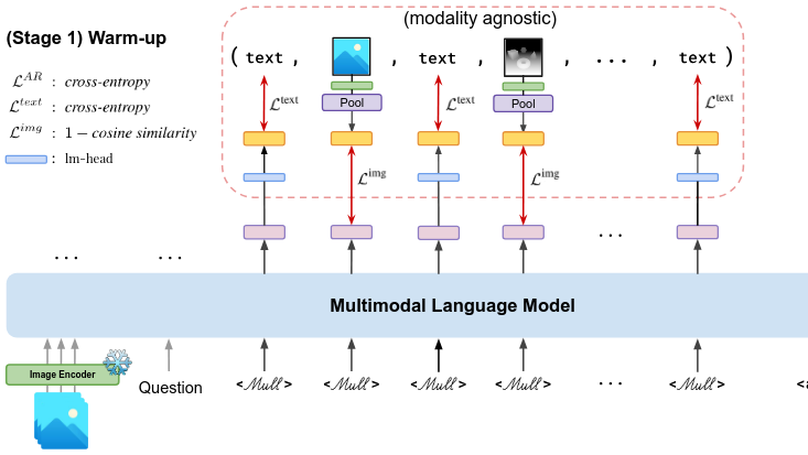
Reasoning goes beyond language; the real world requires reasoning about space, time, affordances, and much more that words alone cannot convey. Existing multimodal models exploring the potential of reasoning with images are brittle and do not scale. They rely on calling specialist tools, costly generation of images, or handcrafted reasoning data to switch between text and image thoughts. Instead, we offer a simpler alternative – Mull-Tokens – modality-agnostic latent tokens pre-trained to hold intermediate information in either image or text modalities to let the model think free-form towards the correct answer. We investigate best practices to train Mull-Tokens inspired by latent reasoning frameworks. We first train Mull-Tokens using supervision from interleaved text-image traces, and then fine-tune without any supervision by only using the final answers. Across four challenging spatial reasoning benchmarks involving tasks such as solving puzzles and taking different perspectives, we demonstrate that Mull-Tokens improve upon several baselines utilizing text-only reasoning or interleaved image-text reasoning, achieving a +3% average improvement and up to +16% on a puzzle solving reasoning-heavy split compared to our strongest baseline. Adding to conversations around challenges in grounding textual and visual reasoning, Mull-Tokens offers a simple solution to abstractly think in multiple modalities.

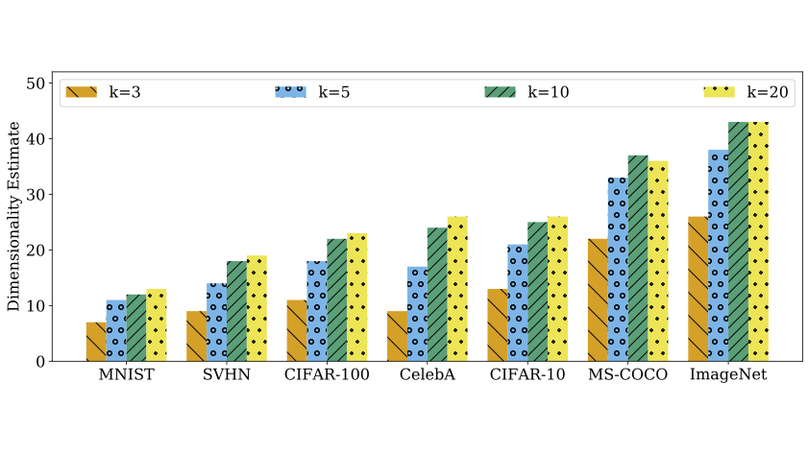
It is widely believed that natural image data exhibits low-dimensional structure despite the high dimensionality of conventional pixel representations. This idea underlies a common intuition for the remarkable success of deep learning in computer vision. In this work, we apply dimension estimation tools to popular datasets and investigate the role of low-dimensional structure in deep learning. We find that common natural image datasets indeed have very low intrinsic dimension relative to the high number of pixels in the images. Additionally, we find that low dimensional datasets are easier for neural networks to learn, and models solving these tasks generalize better from training to test data. Along the way, we develop a technique for validating our dimension estimation tools on synthetic data generated by GANs allowing us to actively manipulate the intrinsic dimension by controlling the image generation process.

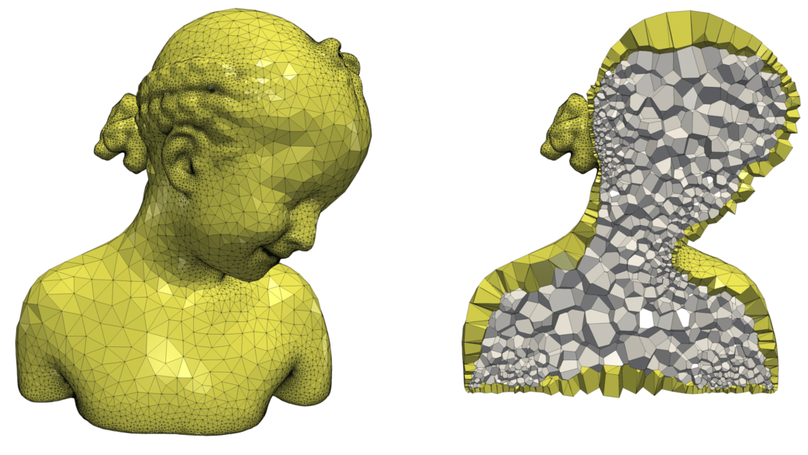
Polyhedral meshes are increasingly becoming an attractive option with particular advantages over traditional meshes for certain applications. What has been missing is a robust polyhedral meshing algorithm that can handle broad classes of domains exhibiting arbitrarily curved boundaries and sharp features. In addition, the power of primal-dual mesh pairs, exemplified by Voronoi-Delaunay meshes, has been recognized as an important ingredient in numerous formulations. The VoroCrust algorithm is the first provably correct algorithm for conforming polyhedral Voronoi meshing for non-convex and non-manifold domains with guarantees on the quality of both surface and volume elements. A robust refinement process estimates a suitable sizing field that enables the careful placement of Voronoi seeds across the surface, circumventing the need for clipping and avoiding its many drawbacks. The algorithm has the flexibility of filling the interior by either structured or random samples while preserving all sharp features in the output mesh. We demonstrate the capabilities of the algorithm on a variety of models and compare against state-of-the-art polyhedral meshing methods based on clipped Voronoi cells establishing the clear advantage of VoroCrust output.
Ventures into teaching